
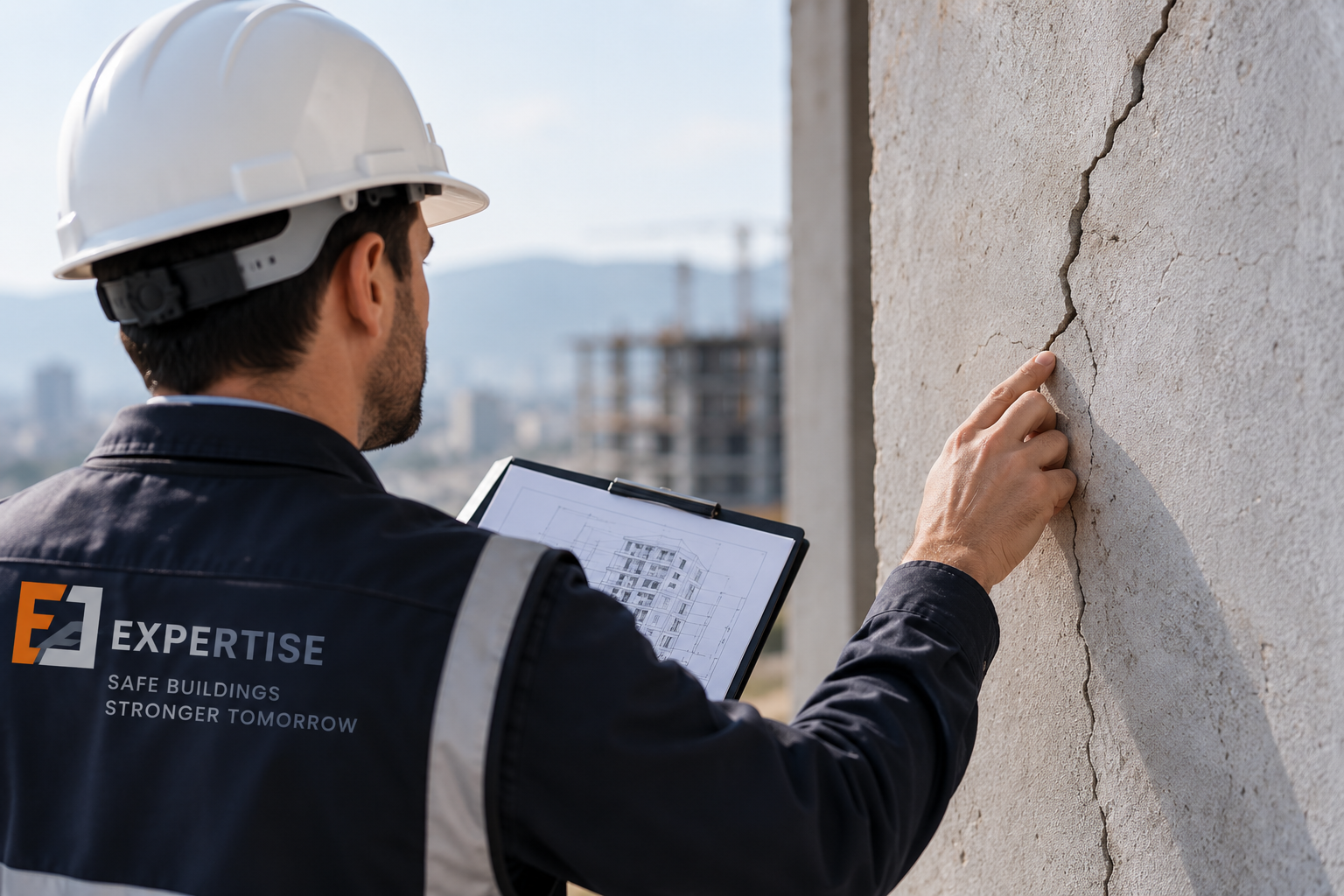
A crack appearing on a wall or ceiling often causes concern for the building owner. However, it is not always possible to determine from visual signs alone whether the crack represents a real structural problem.
Some damage affects only the finishing layer, while in other cases the issue may be related to the structural elements of the building.
That is why it is important to consider not only the presence of a crack, but also its location, shape, size, development over time, and the overall condition of the building.
What Can Cause Cracks to Appear?
There is no single universal cause of cracking.
Cracks may be influenced by the age of the building, soil conditions, changes in loads, improperly executed construction work, reconstruction, environmental conditions, or various structural factors.
Sometimes the damage remains unchanged for years, while in other cases it gradually increases.
Therefore, determining the exact cause of a problem based only on a photograph or visual observation can be difficult.
When Should You Consult a Specialist?
A professional assessment is particularly recommended if:
- the crack increases over time;
- cracks appear on several structural elements at the same time;
- deformation is observed in the building;
- doors or windows no longer open and close as they used to;
- the damage appeared after construction or reconstruction works;
- there are signs of corrosion, spalling, or significant deterioration of materials;
- reconstruction or major alterations to the building are planned.
In such cases, a technical condition inspection of the building allows the problem to be assessed more systematically.
How Is a Technical Condition Inspection Carried Out?
The inspection process depends on the specific property and the task to be addressed.
During the inspection, specialists may assess the condition of the foundation, columns, walls, floor slabs, or other structural elements.
In addition to visual inspection, control measurements and photographic documentation may be carried out. Where necessary, additional investigation methods may also be used.
This approach makes it possible to assess not only the specific damage itself, but also its relationship to the overall structure of the building.
Why Should the Problem Not Be Ignored?
A defect related to the condition of a building does not always indicate an immediate danger, but ignoring it is not the right approach either.
A timely assessment can help determine:
- whether the damage is significant;
- whether additional investigation is required;
- whether repair or structural strengthening is recommended;
- whether the building can continue to be used in its current condition.
The main goal is to ensure that decisions are based not on assumptions, but on a professional technical assessment.